[syndicated profile] alpennia_feed

Posted by Heather Rose Jones

Saturday, October 17, 2026 - 07:00

Lesbian Historic Motif Podcast - Episode 354 - Why is Intersexuality Relevant to the History of Lesbianism? - transcript

(Originally aired 2026/10/17)

Content Note

Let’s start with a content note. Historic discussions of intersexuality have a hard time avoiding the word “hermaphrodite,” which today is considered offensive when applied to intersex persons. However, in historic use, “hermaphrodite” was used in a variety of contexts to indicate combinations of masculine and feminine attributes and applied to the entire spectrum of sex, gender, and sexuality. This could include people with ambiguous genitalia, but also people who combined aspects of performative gender assigned to both men and women, or who performed gender attributes not matching their assigned sex. Pre-modern gender theory did not clearly distinguish these concepts. I acknowledge that the use of the word “hermaphrodite” in the context of intersexuality is considered offensive today and apologize for any harm that discussing the historic usage may cause for readers. As the historic use of the word applies to a semantic complex for which there is no neutral corresponding term today, it’s hard to avoid the word entirely.

As usual, I’ve focused this discussion on Western, largely Christian culture in keeping with the primary focus of the Project. As intersex is a natural, rather than a cultural, phenomenon, every culture can be expected to have some way of recognizing and addressing it. There is an extensive discussion of intersexuality in Xie’s dissertation on historic Chinese attitudes toward gender deviations. DeVun includes discussions of intersex within Jewish and Arabic traditions. As the topic is tangential to the focus of the Project, I haven’t specifically sought out work on other cultures.

Discussion

So why is intersexuality relevant to the history of lesbianism?

Within a cultural context where physiological sex, performative gender, and sexual preference are expected to march in parallel, any deviation from the expected alignment is a social disruption. People causing such disruptions have, at various times, been classified as “hermaphrodites” although different eras emphasized different aspects of the equation, and other labels are also possible. Interpretations of, and reactions to, such deviations will either stigmatize the individual (variously as sinful, monstrous, criminal, diseased, or some other framing) or will attempt to reanalyze the deviation to restore the expected alignment in a way that requires the least cognitive dissonance. For example, it might be argued that the sex assignment was incorrect, or that the gender performance was due to economic reasons.

If we take as a fixed frame of reference a situation that produces the appearance of same-sex desire between women, then we can explore how the society handles deviations of performative gender or physiological sex. Deviations of performative gender fall more under the topic of female masculinity and are out of scope for this episode. Deviations of physiological sex correspond loosely to intersexuality and raise questions of how sex is identified and categorized. Historic debates around the nature and sexual classification of intersex people can shed light on cultural understandings of “who is a woman?” and “what does it mean to be of the same sex?” as well as the question “who gets to decide?”

While modern classification as intersex can encompass issues of anatomy, chromosomes, hormones, and reproductive organs, prior to the 20th century (and the ability to identify chromosomal and hormonal factors), sex classification was focused on visible genitalia and secondary sex characteristics, with behavioral aspects brought in when those failed to provide a clear answer. More specialized considerations of internal anatomy began to be available around the 19th century. Most academic studies of the history of sex difference don’t address intersexuality in any meaningful way, lumping in anatomical ambiguity with behavioral gender transgression (such as cross-dressing or homosexuality) but we can trace historic attitudes toward intersexuality within those studies.

Common visible intersex conditions might manifest as a smaller than typical penis or an enlarged clitoris, or a combination of an apparent penis of some size with an apparent vaginal opening, though not necessarily large enough to enable penetrative sex, or some other variation. There is a much wider range of less visible intersex conditions, but these are less likely to have contributed to pre-20th century ideas about sex and gender. While estimates of the prevalence of intersex conditions vary widely, they are common enough to justify historic models of sex trying to account for the phenomenon.

The “one-sex” model of sexual difference, originating in classical times, allowed for a sliding scale of categorization, with male at one end, female at the other end, and various types of intermediate or ambiguous bodies and behaviors in between. Intermediate forms under this model of sexual differentiation were not identical to the classical idea of the “androgyne”—a perfect melding of male and female—but rather represented a failure to adhere to the ideals of purely male or purely female. Although the one-sex model wasn’t systematically displaced in medical theory until the early modern period, philosophical debates during the 12th century tackled the question of just how to draw dividing lines and whether “hermaphrodites” represented an intermediate state or an entirely separate “third sex.” To some extent, these debates, rather than undermining a gender binary, called for stricter gender boundaries (a situation that would recur in the 19th century). Regardless of the difficulty in classifying ambiguous bodies, it was considered essential to have a metric for doing so, as sex classification was the basis for social and legal identity.

Because of this surge of interest in “hermaphrodites” in the 12th century (which would wane in following centuries before reviving in the 16th century), we can examine a snapshot of the attitudes of various parts of medieval society. Medical writings tended to accept a three-sex model, including a “neither male nor female” category based on anatomy. Theological writings—concerned with the possibility of sodomy—declined to recognize a formal “third sex” and assigned a sexual category based on sexual response and capacity. Someone who was sexually “more active” could be classified as a man, or if “more passive,” as a woman. But if they “failed” at this classification they were not allowed to switch and must instead remain celibate.

While philosophy and medicine allowed space to debate the fuzziness of sex and gender categories, the law had no such luxury. It recognized only two sexes and enforced clear and drastic differences in what rights the two had. No one could escape the requirement to be legally classified as either male or female. Roman law—which continued to influence European legal systems throughout the middle ages—held that an intersex person would be classified according to the “preponderance of their traits” with a focus on anatomy, but it remained fairly silent on the question of who would make that classification. Various approaches were taken in various contexts to make this assignment, based on the appearance or functionality of the genitals, and sometimes taking into account behavioral gender factors, if anatomy provided no clear guide.

Assignment into a sex category could be particularly fraught if the question arose later in life. Some intersex conditions only become apparent at puberty, when a female-appearing body develops more masculine-appearing genitals, or when a body that appeared to be an under-developed male began to menstruate. Such cases are likely to have contributed to the belief prevalent in classical and medieval times that bodies could change physiological sex. In some cases, this was thought to be a random and spontaneous occurrence, but there was an associated belief that cross-gender behavior could result in a change of corresponding sex.

Classical and medieval authorities concurred that spontaneous change of sex was almost always from female to male, explained as nature moving from the imperfect (female) to the perfect (male). While behavior-mediated sex change could, in theory, occur in either direction, the vast majority of the examples cited in the literature are from female to male. Traces of a belief in behavior-driven sex change can be found as late as the 19th century when women were discouraged from participating in male-coded activities for fear it would affect their reproductive capacity.

While some such sex-change narratives may have been inventions, there are conditions that manifest as a child appearing to have anatomy associated with one sex, but on puberty developing sexual characteristics of a different sex. For example, the genetic condition 5α-Reductase 2 deficiency can result in a chromosomally XY infant being classified as female, but then developing more typically male genitals at puberty. As a recessive genetic trait, this condition might appear randomly in the population and could easily have been the inspiration for a belief in spontaneous female-to-male sex change.

In an environment where the idea of such changes was accepted, some people may have claimed to have undergone a sex change even when not supported by their anatomy, either to live as a man (gender identity) or to engage in socially acceptable relations with a woman (sexual preference). In 16th century Spain, Elena de Céspedes (after marrying a man and bearing a child) took on the name Eleno and began living as a man, including marrying a woman. When questions later arose about their identity, Eleno justified their actions by claiming to have developed male genitals that were later lost in an accident.

Official interest in cases of intersexuality focused around two concerns: reproduction and same-sex relations. From the medieval period up through the 20th century, investigations into proper sex categorization were often raised due to the perceived inability of one partner in a marriage to fulfill the expected sexual role of their assigned sex. (This concern could be driven by male impotence as well as by anatomical concerns.) The annulment of a marriage due to reproductive incapacity sometimes involved re-categorizing the person’s sex, but sometimes simply concluded that they couldn’t perform adequately according to their correctly-assigned sex, or that it was impossible to determine a correct sex classification.

A separate concern was that, due to mis-classification, someone was inadvertently engaging in same-sex acts. The flip side of this concern was that an incorrect re-classification of someone’s sex might result in same-sex acts. As a general rule, a person was only allowed one sex reclassification. Acting as the “wrong” sex was forgivable before the matter had been adjudicated, but a second reassignment meant the person had been knowingly and willfully acting as the “wrong” sex. If they had engaged in marriage or sexual relations in both sexual categories, that raised moral questions as well as legal ones.

A clear-cut case of intersexuality which raised both concerns was recorded in 17th century Virginia when Thomas or Thomasine Hall was challenged due to a history of having sexual relations with both men and women and having lived alternately as a woman and a man. A medical examination confirmed Hall’s claim to be both male and female, leaving the law befuddled as to how to classify them, though the record indicates that the concern was more about gender transgression than about which of Hall’s sexual activities was problematic.

Beginning around the 16th century, and especially within medical circles, another topic that brought lesbianism and intersexuality into overlap was the renewed fascination with the clitoris as a sexual organ and the association of clitoral enlargement with sex between women. (This is an entire topic on its own and there will be a podcast about it eventually.) Factual reports of intersex people who combined female-appearing genitals with a micro-penis are likely to have contributed to the idea of the “macro-clitoral lesbian,” but the latter image took on a life of its own. When reading reports and case histories from earlier eras, it isn’t always possible to determine whether the subject of the discussion is intersex, or whether the observer is ignorant of the range of anatomical variation, or whether non-normative behavior is being reinterpreted as non-normative anatomy. There are numerous cases of apparent female same-sex desire being a trigger for investigating one of the partners to see if they had masculine-appearing anatomy, as in the early 17th century case of Marie or Marin le Marcis who was acquitted from a charge of “female sodomy” by a doctor’s opinion that Marcis had sufficiently masculine anatomy to explain desire for a woman, but not sufficient to be legally classified as a man. (Marcis was then legally forbidden from having sexual relations with either sex, to avoid any possibility of same-sex relations.) One motivation for attributing (apparent) female same-sex desire to “hermaphroditic” anatomy, was the ability to reclassify such people as a type of “third sex,” thus excluding the possibility that “normal women” could have same-sex desires.

This approach faded with the rise of the “two sex model,” under which male and female were considered to be entirely separate states of being. The theory was that everyone clearly had an underlying “true sex” that must be determined, rather than allowing that someone might be intermediate between the sexes and assigned to a category based on a best fit, or to a third category entirely. Previously there was some latitude for considering a person’s social presentation or even personal preference. Some medieval jurisdictions allowed an intersex person to swear to which sex they would live as, rather than being assigned a sex by the authorities. But under the two sex model, medical expertise began to claim jurisdiction over questions of sex categorization.

Advances in the study of anatomy and improved understandings of the biology of reproduction in the later 18th and 19th centuries pared away some of the mythology around intersexuality, without disrupting the idea that everyone had an underlying “true sex” and that there was a physiological basis to gender identity. It continued to be the case that people who deviated from a normative alignment of sex, gender, and sexual preference were perceived as a problem to be solved, but the issue was interpreted in new ways. The “masturbation panic” of the 18th century introduced the idea that what appeared to be a penis-like clitoris could be caused by masturbation rather than being evidence of a male body. At the same time, the prior belief that a naturally-occurring enlarged clitoris (or micro-penis) indicated an intermediate or “third” sex was redirected toward a need to classify the body unambiguously as male or female. Even as medical publications spread awareness of the reality of intersex conditions, they were still treated as a problem to be solved.

The increasing medical acceptance of intersexuality was deployed to try to avoid recognizing same-sex desire. Witness the 18th century French case of Anne or Jean-Baptiste Grandjean who, after growing up unquestioned as female, was instructed by their confessor to live socially as a man due to having expressed sexual desire for women. Several years after marrying a woman, this transgender solution was rejected by a court who convicted Grandjean of “contempt for the sacrament of marriage.” On appeal, Grandjean’s lawyer used a claim that his client was intersex (a claim that had not been made in prior medical examinations) as a defense. The multiple medical examinations of Grandjean came to different conclusions, leaving the truth of the matter unclear, but the point was that a reassignment of sex category—or at least a legal recognition of ambiguity—would have been the only acceptable defense for the marriage.

In the 19th century, the French situation became more complicated because the Napoleonic law code required all infants to have their sex registered within three days of birth, but also made no allowance for any classification other than male or female. This made France central to medical debates over how to classify ambiguous bodies. Doctors developed elaborate and contradictory strategies for determining an official sex assignment, while the law courts had to deal with the consequences of initial sex assignment of infants that were later called into question.

Outside of France, references to a “third sex” could encompass intersex people as well as developing sexological theories around same-sex desire. By the 19th century, intersexuality was starting to go out of fashion as an assumed explanation for gender crossing. But once a person was identified as intersex, that fact might be applied retroactively as explanation for all manner of deviations from expected gendered behavior. The case studies offer a detailed catalog of the attributes and behaviors that were considered to be biologically tied to sex. Sexologists introduced the idea that this physiologically-based gender identity could be at odds with one’s apparent anatomy, which developed into the idea of “gender inversion,” while still assuming that gender identity drove sexual preference. Sexology set out to develop a scientific approach to questions of sex, gender, and sexuality but continued to treat the three as hopelessly intertwined.

Returning to the question of “how is intersexuality relevant to lesbianism,” we must consider the core historic prototype. Sex, gender, and sexual desire were expected to align in specific ways. For much of Western history, these three topics were not treated as distinct. Although we can find language discussing anatomical sex, behavioral gender, and sexual preference, they were not considered to be independent characteristics. Similarly, although historic cultures recognized and described deviations from the default alignment, those deviations were not “bundled” into the same identity categories that have developed across the 20th century. So, for example, the term “hermaphrodite” could refer to any misalignment. Where today’s approach might refer to a deviation of sexual preference as “homosexual,” a deviation of gender as “transgender,” and a deviation of sex as “intersex” (as a vast oversimplification), these were not necessarily meaningfully distinct categories prior to the turn of the 20th century.

The attribution of masculinity to women who desired women was the flip side of the authorities using desire for women as evidence for masculinity in intersex persons. The attitudes are thoroughly intertwined. When doctors and other professionals trying to assign sex to an ambiguous body prioritized avoiding the appearance of authorizing same-sex desire, we can see a reflection of how some unambiguously female bodies were assigned masculine gender in order to make sense of their desire for other female bodies. The people with those female bodies might embrace or reject that assignment of masculinity, but the pressure was there. Similarly, when behavioral attributes like “enjoying active sports” or “having a scientific mind” were considered diagnostic when evaluating cases of unclear sex, we can better understand why women in history might label themselves “masculine” for similar interests without necessarily experiencing what we would understand today as gender dysphoria. All of this complicates the historic analysis of same-sex and same-gender desire. Thus we can see that exploring the intersection of lesbianism and intersexuality helps in identifying the underlying cultural assumptions and models that shape both social attitudes towards lesbianism and the self-understanding that women may have had about their own identities and desires.

References

Brown, Kathleen. 1995. “’Changed...into the Fashion of a Man’: The Politics of Sexual Difference in a Seventeenth-Century Anglo-American Settlement” in Journal of the History of Sexuality 6:2 pp.171-193.

Burshatin, Israel. “Elena Alias Eleno: Genders, Sexualities, and ‘Race’ in the Mirror of Natural History in Sixteenth-Century Spain” in Ramet, Sabrina Petra (ed). 1996. Gender Reversals and Gender Cultures: Anthropological and Historical Perspectives. Routledge, London. ISBN 0-415-11483-7

DeVun, Leah. 2020. The Shape of Sex: Nonbinary Gender from Genesis to the Renaissance. Columbia University Press, New York. ISBN 978-0-2311-9551-5

Donoghue, Emma. 1993. “Imagined More than Women: Lesbians as Hermaphrodites” in Women’s History Review 2:2 199-216.

Laqueur, Thomas. 1990. Making Sex: Body and Gender from the Greeks to Freud. Harvard University Press, Cambridge. ISBN 0-674-54349-1

Linton, Anne E. 2022. Unmaking Sex: The Gender Outlaws of Nineteenth-Century France. Cambridge University Press, Cambridge. ISBN 978-1-316-51182-4

Manion, Jen. 2020. Female Husbands: A Trans History. Cambridge University Press, Cambridge. ISBN 978-1-108-48380-3

Nederman, Cary J. and Jacqui True. 1996. “The Third Sex: The Idea of the Hermaphrodite in Twelfth-Century Europe” in Journal of the History of Sexuality 6:4: 497-517.

Vermeil. 1765. Mémoire pour Anne Grandjean. Louis Cellot, Paris.

Xie, Wenjuan. 2015. (Trans)Culturally Transgendered: Reading Transgender Narratives in (Late) Imperial China. Dissertation.

Show Notes

In this episode we talk about:

  • Historic understandings of intersexuality
  • The intertwined models of sex, gender, and sexual preference
  • How avoiding homosexuality drove approaches to intersex sex assignment
  • This topic is discussed in one or more entries of the Lesbian Historic Motif Project here: Intersex
  • A list of references can be found in the transcript

Links to the Lesbian Historic Motif Project Online

Links to Heather Online

Major category: 

2026.10.17

Oct. 17th, 2026 11:21 am
lsanderson: (Default)
[personal profile] lsanderson
Twin Cities Horror Fest brings South Asian mythology and Mexican ghost stories to Minneapolis
Plus, explore St. Paul’s Solidarity Street Gallery and see Titus Kaphar’s paintings and film about Black generational trauma at the Minneapolis Institute of Art
by Myah Goff
https://sahanjournal.com/arts-culture/twin-cities-horror-fest-soildarity-street-gallery-mia/

Amid ACLU lawsuit, Detroit Lakes school board committee tables new rules for what teachers can display
Harshawn Ratanpal
https://www.mprnews.org/story/2026/10/17/detroit-lakes-rainbow-ban-on-pause-amid-aclu-lawsuit ( Read more... )
rolanni: (Default)
[personal profile] rolanni

Business first: For those interested: the ebook edition of Kin Right is now available for preorder from all of the usual suspects.

Amazon link provided as a courtesy.

No, I do not know when -- or even if -- an eARC will be available. Baen appears to be shifting things around. All questions regarding Baen Systems are properly directed to Baen. Thank you for your understanding.

Amazon link to Kin Right ebook preorder page

#
Saturday. Today is Do Something Completely Different Day™. I'm really on the wrong track with what I've written the last couple of days. This means that the boys in the basement need to get in some more beer and stop slacking off -- a process that historically goes much better if I'm not standing behind their shoulders.

I will therefore be sorting photographs today and either listening to music or to Saratoga Trunk, which I downloaded in a fit of nostalgia.

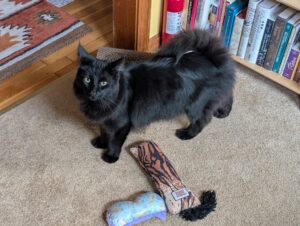
It is for the record a slightly glary morning with a vigorous breeze in the trees and there is a Coon cat making biscuits on my lap.

What's the day like at your house?


Rook

Firefly


Bat Shirt


Posting on Anon on AO3

Oct. 17th, 2026 09:54 am
duckprintspress: (Default)
[personal profile] duckprintspress

a guest post by, unsurprisingly, anonymous!

Why Post Anonymously?

Have you ever wanted to write a fic, but the idea of being perceived felt scary? Have you ever wanted to write something strange, or weird, or too kinky, and didn’t want your usual username associated with it?

Boy, do I have news for you.

There are many reasons why someone may want to not have their name associated with a work they want to post.

There are people who are shy, or scared of being perceived, and having a name attached to it may be daunting. There are people who want to explore a theme, genre, or kink, that doesn’t “match” their online persona, or that they’re not too comfortable or familiar with.

No matter the reason, AO3 does not judge, and is here to help.

Ways on AO3 to separate your name from a work

There are several ways to go about posting without it being attached to your account like a pseud. You can create a separate AO3 account with a different email, orphan a work posted under your name, and post under Anonymous.

There are pros and cons to each option:

  1. Having separate accounts gives you full control, but you are managing a whole new account.
  2. Orphaning a work removes you entirely and it is irreversible. You don’t get emails about comments or kudos, you cannot reply to comments unless you’re okay with your AO3 account being associated with it, you cannot edit or change the title, tags, or content, and your name is removed from the work.
  3. Posting or adding your posted work to an Anonymous Collection (such as this one). The story remains yours, you can edit, delete, reply to comments, and if at any point you decide you want to take ownership back, you can always remove it from the collection.

As you can see, posting on Anon gives you a lot of flexibility. You retain full control over the story, can reply to comments as the author (as Anonymous Creator), and you can always take the story out of the Anonymous Collection at any time.

Just remember that if you’re logged in, your Works won’t appear on your dashboard or Works, but don’t panic they’re still there. You can access them by going to your works, then at the top right corner you’ll see a button called Works in Collections, which will include the ones you have in Anon Collections. Alternatively, you can go to your Stats page, where you will find all works associated with your account, anon or otherwise.

A screen capture from the "works" page of someone's AO3 account, with the name and number of works and number of pages blacked out. The "works in collections" button is selected, and four red arrows point to it.

Don’t be scared if you see the author as Anonymous [Your AO3 name], that’s only visible while you’re logged in. If worried you can always check on an incognito tab.

This feature has given me the freedom to poke, and shake out the weird out-of-pocket thoughts lurking in my head without having to explain myself to my friends or user subscribers. And not everyone will relate, but knowing nobody (except the people subscribed to a multichaptered story) is receiving an email when I post has been very healing.

Of course, even as an anon fic, it has to respect AO3’s guidelines and other AO3 users: it must be tagged appropriately, can’t be a placeholder or idea dump, and cannot include anything else not allowed on AO3.

Posting to an Anonymous Collection

To make a posted work anonymous, you have to go to Edit Work, then to the section about Collections, and add it to an anonymous collection.
A screen capture from Archive of Our Own, showing the Post to Collections/Challenges box. The word "anonymous" has been entered into the box, and a list of suggested anonymous collections follows.

To post directly as Anonymous, first you go to an anonymous collection, and find the button Post to Collection.

A screen capture from the Archive of Our Own collection Anonymous, showing the header area of the Dashboard page for the collection. The "Post to Collection" button is pushed down and has three red arrows pointing to it.

You can create a new anon collection, but while the work won’t appear under your name, the collection will. If that is a concern of yours, choose one of the many anon collections available, making sure it is: Open, Unmoderated, Anonymous, but personally I prefer this collection

Hope this information has been helpful to someone. And whether you choose to post on anon or not, good luck!


dolorosa_12: (sunflowers)
[personal profile] dolorosa_12
One final link that I wanted to keep separate from the previous culture/sociological linkpost is this call to donate to a Ukrainian grassroots initiative in which a retired engineer has converted an old tractor so that it can be operated remotely to clear mined land more safely (i.e. with human operators removed to a safe distance).

Ukrainian authorities estimate that more than 30% of their country (179,000 square kilometres) is mined, making it the most mined country on Earth, so the task to clear the land of mines is obviously an incredibly daunting one.

One of the posts that didn't make the cut for the previous links round-up involved a lot of discussion in the comments section about what really constitutes hope, but for me, the answer (reinforced by what I've witnessed and experienced these past few years, and my own values) is clear. Hope is not a utopia: it is an action, both collective and individual, and in this action, we find the antidote to despair.

I cannot think of any clearer demonstration of hope than the work of the individuals involved in this minesweeping initiative, nor the organisation facilitating the fundraising.

I can vouch for the legitimacy of the individuals involved, and, as always, only share calls for donations in contexts in which I personally would be comfortable donating my own money (as I have done in this case).

Please feel free to share this post, or directly link to the fundraiser.

Rainy Saturday linkpost

Oct. 17th, 2026 02:05 pm
dolorosa_12: (fountain pens)
[personal profile] dolorosa_12
One new — and incredibly rewarding — change I've made recently is to subscribe to a lot of email newsletters on social and cultural issues (as opposed to my previous subscriptions, which consisted purely of political content). Most of these newsletters come out on Fridays or Saturdays, meaning my weekends begin with a steady stream of interesting, but not exclusively politically stressful, reading material. I guess it's a replacement for the features sections in the printed Saturday newspapers that I grew up reading at the start of each weekend over breakfast.

This also means that by Saturday lunchtime, I tend to have an interesting array of links to share. I'm not sure this will become a regular weekly feature, but for now, here is this week's post.

Before I get to the links, just a quick note that I'm implementing a slight tweak in how I structure these links roundups. This is mainly because I personally find it irritating when — in particular — a longform video, shortform video, or audio link is not clearly identified as such (I'm sorry, I may be old-fashioned, but if something is described as a 'review,' I'm expecting text, not a Youtube video essay or TikTok video; I cannot emphasise enough that this is a Me Problem, but I have noticed it as a recent cause of annoyance, so I'm going to be the change I want to see!). So, I'm going to state the source and format of the link in square brackets [e.g. video essay, Youtube] so that — if such things affect people's interest in clicking through — they have all the information they need from the start.

From left to right in my open tabs:

It is only when we imagine that our ability to act has nothing to do with the body that we end up taking seriously the idea that we can live contentedly as machines. Far from upskilling us, a technology that shuts us off from embodied learning risks diminishing the intelligence it seeks to enhance: The more we rely on tech, the more we deskill our bodies [Melanie Challenger; longform essay; Aeon]

Every good friendship deserves governance really got me looking critically at my own life [Olly Rowe; longform essay; Substack]

The culinary history of salted caramel [Doug Mack; newsletter; personal Snack Stack website]

Streaming platforms give us access to new music, so why are fewer people listening to it? This digs into specifically Australian data, but I suspect it's broadly comparable elsewhere. [Tim Kelly; longform essay; The Conversation]

'Merbraids', a new-to-me braided speculative poem in which sirens of the sea, river and lake make their respective cases [Amal El-Mohtar, Caitlyn Paxson, and Jessica P. Wick; poetry; Mermaids Monthly]

'Sir Gawain Fucks the Green Knight' (fairly self-explanatory speculative poetry!) [Kym Deyn; poetry; Bluesky]

Regulate your nervous system by watching Olia Hercules cook borsch for an hour and a half in real time [Olia Hercules; video; Patreon]

And now I can close all those tabs that I've accumulated since Friday!
james_davis_nicoll: (Default)
[personal profile] james_davis_nicoll


Seven books new to me. Three fantasies, one horror (unless it's not), two SF, and one anthology that is both fantasy and SF. At least two are series books.

Books Received, October 10 — October 16


Poll #35202 Books Received, October 10 — October 16, 2026
Open to: Registered Users, detailed results viewable to: All, participants: 18


Which of these look interesting?

View Answers

Love, Witches, and Wahala by Christine Cowan (November 2026)
2 (11.1%)

We Used to Be Heroes by Thomas Elrod (May 2027)
7 (38.9%)

Year’s Best Canadian Fantasy and Science Fiction: Volume Four edited by Stephen Kotowych (October 2026)
8 (44.4%)

Massif by Garth Nix (October 2026)
11 (61.1%)

As We Fall Through Time by Claire North (October 2026)
6 (33.3%)

We Won’t Be Here When It Ends by Mark Oshiro (April 2027)
4 (22.2%)

A Magical Girl Rehired by Seolyeon Park (December 2026)
5 (27.8%)

Some other option (see comments)
0 (0.0%)

Cats!
15 (83.3%)

October Arriving by Charles Simic

Oct. 1st, 2026 11:09 pm
conuly: (Default)
[personal profile] conuly
I only have a measly ant
To think with today.
Others have pictures of saints,
Others have clouds in the sky.

The winter might be at the door,
For he’s all alone
And in a hurry to hide.
Nevertheless, unable to decide

He retraces his steps
Several times and finds himself
On a huge blank wall
That has no window.

Dark masses of trees
Cast their mazes before him,
Only to erase them next
With a sly, sea-surging sound.


*******


Link

Smoke by Henry David Thoreau

Oct. 21st, 2026 11:08 pm
conuly: (Default)
[personal profile] conuly
Light-winged Smoke, Icarian bird,
Melting thy pinions in thy upward flight;
Lark without song, and messenger of dawn,
Circling above the hamlets as thy nest;
Or else, departing dream, and shadowy form
Of midnight vision, gathering up thy skirts;
By night star-veiling, and by day
Darkening the light and blotting out the sun;
Go thou, my incense, upward from this hearth,
And ask the gods to pardon this clear flame.


*******


Link
conuly: (Default)
[personal profile] conuly
"Lovely War meets Howl’s Moving Castle in this new YA fantasy from acclaimed author Frances Hardinge, about the people caught in a game played by the gods where castles are moved around the world like chess pieces" and I gotta say, I'm offended by that blurb. The obvious DWJ parallel is Homeward Bounders, and this book has little, if anything, in common with Howl's Moving Castle.

Definitely worth a read, though.

*************************


( Read more... )
[syndicated profile] alpennia_feed

Posted by Heather Rose Jones

Friday, October 16, 2026 - 15:00

For years, as I've been reading historic research related to lesbianism, I've regularly come across topics and people where my first reaction is: "Why isn't the question of intersex being raised here?" A very few authors have integrated the topic into a general history of sexuality, but eventually I decided to pick up some more focused studies. Now I keep having to remind myself that intersexuality is tangential to my central topic and I shouldn't go haring off after biographies and whatnot. Tomorrow's podcast will integrate my thoughts on why I consider it interesting and important to discuss intersexuality in the context of lesbian history. And then maybe I can set the topic aside and return to my lane.

Major category: 
Full citation: 

Linton, Anne E. 2022. Unmaking Sex: The Gender Outlaws of Nineteenth-Century France. Cambridge University Press, Cambridge. ISBN 978-1-316-51182-4

Part I: A Cultural Prehistory of Intersex from the Archives; Chapter 1 Prescribed Fictions: Stories of “Hermaphrodisim” vs. “True Sex”

[Note: The author assumes a detailed knowledge of the central topic of the chapter, Herculine Barbin. To contextualize the material, here is some background, based largely on Wikipedia. Barbin was classified as female at birth and was educated at a convent school. There she fell in love with a fellow female student, then later with a fellow female teacher. Severe abdominal pain led her to a series of medical examinations, which identified anomalies in her anatomy.]

The literary style of the memoirs of Herculine Barbin is compared to fictional representations of hermaphrodites. Barbin offers what may be the only firsthand account from a 19th century intersex person. Indeed their memoirs were sometimes treated as fictional, plagiarized for other authors fictions, and appropriated for inclusion in medical reports.

This chapter looks at the purposes and conclusions of medical investigations of intersex people, and how those conclusions relate to the idea that all people have a “true sex.” Doctors came down on both sides of the question, as well as disagreeing about methods of sex determination.

Barbin was born in 1838 and recorded (as required by law) as female. In Barbin’s own writings both female and male gendered forms are used, predominantly female before the medical examinations that resulted in a change of legal sex, and mixed male and female afterward. This distinction is largely erased in English translations, and even the original French must be treated with caution as it survives only in excerpted form, as the original manuscript was lost.

Barbin’s legal sex change was done in 1860 (so when they were about 22). But having been required to change legal sex and start a new life, Barbin struggled to rebuild their life, fell into poverty, and committed suicide in 1868. All of which was recorded in their memoirs.

Barbin predicted that their death would renew medical interest in their case. The excerpted version of their memoirs was published in 1872 by Ambroise Tardieu as part of a study of sexual variation. A century later, Foucault would claim to “rediscover” the memoirs, and assert that they had not previously received much interest. (Not true.) Discussions of Barbin’s life generally pointed to their suicide as a consequence of their erroneous sex assignment at birth (rather than a consequence of the disruption of their life by the imposed sex reassignment in adulthood which Barbin alludes to).

Central to Barbin’s life was the importance of story to understanding and shaping identity. Barbin was well read, and one can’t find various literary influences in the memoirs.

The excerpts in Tardieu’s edition were edited and appropriated for an erotic novel L’hermaphrodite au couvent in 1905 written under a transparent pseudonym by a man who also wrote a medical study of hermaphrodism. The novel also draws on the tradition of convent-set erotica, offering sexual encounters that appear nowhere in the memoirs. Appended to the novel were various case studies, with the purpose of validating the believability of the events in the story. Both the novel and Tardieu’s commentary on the memoirs justify Barbin’s (or the fictional character’s) erotic desire for women as being due to an essential male nature.

Barbin had sought medical treatment due to abdominal pain, thought to be menstrual cramps, but the initial doctor, having observed Barbin’s ambiguous anatomy, made no direct diagnosis, only vague cautions about socializing with young girls. It was Tardieu who diagnosed the pain as due to “strangulation of the seminal gland” internally. Much of the anxiety expressed around “incorrect” sex assignment involved the possibility of a covertly male person having access to young women, with the assumed result of sexual activity.

Medical reports investigating cases of “doubtful sex” were often written in dramatic style: opening with a mystery, maintaining suspense, dropping hints, then finally offering a conclusion. The initial “mystery” could include failure to conform to gender stereotypes, as well as more concrete medical issues. The failure to perform perfect femininity was considered a symptom of inner maleness, and vice versa (although the former seems more common). The belief in this underlying “true sex,” combined with heteronormativity shaped pre-formed conclusions about the proper fate of intersex patients. It’s worth noting that Barbin’s memoirs came to no such conclusion about the underlying cause of their attraction to women.

One school of medical thought held that “true sex” depended entirely on the nature of the gonads present. Superficial anatomy, secondary sex characteristics, socialization, and self identity were irrelevant. In Foucault’s study of the subject he claims that, before this “true sex” approach in the 19th century, intersex people were free to choose their gender category—a claim that’s easily contradicted. Further, even once gonadal “true sex” became the dominant approach, doctors disagreed over individual cases, sometimes modifying their conclusions to achieve the happiest situation for the patient. An example is given of two different scholarly analysis of the same historic case. One held that the diagnosis supported a “gonad-based true sex” approach, while the other showed that the tests used by the doctors produced variable conclusions as to what that “true sex” was.

When standard approaches produced contradictions (or pointed to the necessity of recognizing same-sex desire) then literary techniques might be brought to bear to achieve the desired harmonious result. The desire for identifying a “true sex” and it’s intersection with sexuality contributed to the medicalization of sexuality in the 19th century. It was one more factor that must be brought into alignment to support a complete separation of sex categories.

Louise-Julie-Anna—a patient with conflicting attributes—was told that “her very existence was criminal.” This was based in part on a diagnosis of masculinity due to her failure to perform acceptable femaleness, despite having been categorized as female and living as a woman. Whereupon she sought a second opinion. The first doctor had diagnosed her as a deceptive man. The second doctor, noting both male and female anatomy, while concluding she was a man, noted the evidence for her female self-identification and used feminine language for her. He noted that she had had sexual relations with men (and only men) and exhibited feminine “modesty.” Thus both doctors brought heteronormative gender stereotypes to bear on the question, with opposing conclusions, despite agreeing on the question of gonadal sex.

The original trigger for her examination was a combination of excess facial hair, an organ intermediate in size between a clitoris and penis, and a hernia resulting in a strangulated organ, identified by the original two doctors as an undescended testicle. The pain from this condition had not been addressed by the initial examinations, but she convinced a third doctor to surgically remove the organ, at which point it was declared to be an ovary, not a testicle, though the surgeon later walked this back. In the meantime, the patient reframed her story to seek support for removing the corresponding organ. This evidently raised some concerns as castration was illegal (presumably removing the strangulated organ was a special case), whereas presumably removing an ovary raised no similar concerns. (It isn’t clear from the text what the eventual outcome was.)

Medical debates over “true sex” also addressed the question of whether a “true hermaphrodite”—that is, a person with both functional ovaries and functional testes—was possible. The debate was largely conducted on the basis of theory and of supporting the integrity of previous diagnoses. (There’s an extensive discussion of the details of this debate.) The debate also challenged the French legal requirement for sex categorization within three days of birth, noting that diagnostic features such as menstruation and secondary sex characteristics might not be apparent until puberty.

(There is an extensive discussion of the timeline for theories about “true sex” versus “two hermaphroditism.” The two approaches are found to coexist throughout most of the 19th century.)

Time period: 
Place: 
Misc tags: 

2026.10.16

Oct. 16th, 2026 11:41 am
lsanderson: (Default)
[personal profile] lsanderson
Some rural libraries are letting their users visit during unstaffed hours
In small communities where places to get work done in the evening are scarce, some libraries are offering extended access to their “third space.”
By H. Jiahong Pan, the Daily Yonder
https://www.minnpost.com/greater-minnesota/2026/10/some-rural-libraries-are-letting-their-users-visit-during-unstaffed-hours/

Joe Thompson’s message to Minnesota, a reminder that crime is down and the Wolves’ LaMelo Ball era
by Matthew Blake
https://www.minnpost.com/newsletter/joe-thompsons-message-to-minnesota-a-reminder-that-crime-is-down-and-the-wolves-lamelo-ball-era/ ( Read more... )

Viable Paradise at Oak Bluffs

Oct. 16th, 2026 12:19 pm
sartorias: (Default)
[personal profile] sartorias
The weather has been delightfully cool, even dipping into cold (low 40s!) and I have met, and administers lots of scruples to, three very nice dogs.

Altogether a splendid send-off for my last year doing Viable Paradise (unless they end up needing a pinch-hit instructor, very unlikely)

Some typical sights on my morning walk. (If you like dawn shots, embiggen the last one--the glints of golden sun on the undersides of the clouds delighted me especially)


Marsh

dawn

I've been getting constant reports from home about the horrible heat and winds--my sister has had the power shut down to prevent wildfires, so no A/C, while I have been getting RAIN!
dolorosa_12: (amelie wondering)
[personal profile] dolorosa_12
This week's thread is inspired by a moment on p.10 of Freya Marske's Bodies of Magic, which contains a throwaway paragraph referencing the (sadly now deceased) famous jacaranda tree on Sydney Uni's main quadrangle, in secondary world fantasy terms.

I was so delighted, because the section in the book about a tree in an academic institution's main quadrangle whose purple flowers herald impending exam season doom is such an obvious piece of Sydney Uni lore if you are one of its alumni or alumnae, and yet it will pass by like a piece of worldbuilding furniture if not. It sent me immediately to Wikipedia to confirm that Marske is indeed, like me, an alumna of that university.

So: what is an incredibly specific reference or allusion you've encountered in a work of fiction (in any medium), such that it's obvious to those in the know, and not at all obvious to those who don't share that specific background/set of experiences?

(Apparently I have a Sydney Uni tag, which is news to me.)
duckprintspress: (Default)
[personal profile] duckprintspress
8 book covers, three badges labeled Hello my pronouns are and text atop rainbow gradient. The text reads: 37 Books We Love + a play! for International Pronouns Day. The books are: Withered by A.G.A. Wilmot; A Hundred Vicious Turns by Lee Paige O'Brien; Awakenings by Claudie Arseneault; Love, Lies, and Cryptids by M.L. Nolan; Key Lime Sky by Al Hess; Upright Women Wanted by Sarah Gailey; On a Sunbeam by Tillie Walden; Homebody by Theo Parish.
10 book covers atop rainbow gradient. The books are: All Systems Red by Martha Wells; Translation State by Ann Leckie; Book Boyfriend by Kris Ripper; The Edge of a World by J.D. Rivers; Worst-Case Scenario by Ray Stoeve; Godly Heathens by H.E. Edgmon; Time and Time Again by Chatham Greenfield; Love, Misha by Askel Aden; The Pairing by Casey McQuiston; The (Most Unusual) Haunting of Edgar Lovejoy by Roan Parrish.

10 book covers atop rainbow gradient. The books are: All Systems Red by Martha Wells; Translation State by Ann Leckie; Book Boyfriend by Kris Ripper; The Edge of a World by J.D. Rivers; Worst-Case Scenario by Ray Stoeve; Godly Heathens by H.E. Edgmon; Time and Time Again by Chatham Greenfield; Love, Misha by Askel Aden; The Pairing by Casey McQuiston; The (Most Unusual) Haunting of Edgar Lovejoy by Roan Parrish.
10 book covers atop rainbow gradient. The books are: No. 6 by Atsuko Asano & Hinoki Kino; Gender Queer: A Memoir by Maia Kobabe; The Bruising of Qilwa by Naseem Jamnia; Spell Bound by F.T. Lukens; Boys Weekend by Mattie Lubchansky; Acting the Part by Z.R. Ellor; Wavelength by Cale Plett; Daybreak by Moosopp; Soulstar by C.L. Polk; I Was A Teenage Death God by M.J. Beasi.
10 book covers atop rainbow gradient. The books are: A Psalm for the Wild-Built by Becky Chambers; What Moves the Dead by T. Kingfisher; Can't Take That Away by Steven Salvatore; Phase Shift by Terra P. Waters; Black Sun by Rebecca Roanhorse; Dear Wendy by Ann Zhao; When the Tiger Came Down the Mountain by Nghi Vo; Have You Seen This Girl by Nita Tyndall; Beyond The Binary: Eight Non-Binary Plays from Next Stage Press; Aether Beyond the Binary ed. by Nina Waters.

Wednesday, October 21st is International Pronoun Day, and so we put together a list of books featuring characters who use pronouns other than she/her or he/him – they/them, she/ or he/them, it/its, neopronouns, or anything along those lines – all are included in this list! The contributors to the list are: Lucy K.R., Tryan A Bex, Shadaras, JD Rivers, Rascal Hartley, Shannon, Neo Scarlett, Mikki Madison, Nina Waters, Nova Mason, Terra P. Waters, CarCrash, Linnea Peterson, and 2 anonymous contributors.

Find these and other books on our Goodreads book shelf, Pagebound list or buy them through the Duck Prints Press Bookshop.org affiliate page.

Join our Book Lover’s Discord server to chat books, fandom, and more!


Damp Friday Thoughts

Oct. 16th, 2026 10:27 am
rolanni: (Default)
[personal profile] rolanni

Friday. Rainy and chill. Sarah will be here in a few minutes to do her magic.

Rook wandered around this morning, calling for Tali to come chase springs with him. The Tali-come-play call is pretty distinctive, which is how I'm able to discern his intention. He was willing to chase springs without backup, so there is that.

I'm lately reading all kinds of things about how the information about Who We Are that's given us by our parents/caregivers/peers as children stay with us all our lives. There are so many agreements to these posts and articles that I'm starting to wonder where are the popular children who excluded and taunted us now?

That aside. . . it comes to me that one can accept other roles, once one is free from the father who explained very patiently how very lazy you are, or the mother who tried to "beat sense" into you, and, yes, the other children who thought you were weird -- and they probably weren't wrong, given the rest of it.

I, for instance, lucked into friends who valued "weird thinking" as "creative." Since several were themselves highly creative individuals, I had to believe that they knew what they were looking at. So, I began to take my own stories, and my attempts at writing them down, not as a waste of time, but something that had some value. Since being "weird" seemed to be attached to my art, I slowly began to try to work with my brain -- an exercise that continues to this day. While we still do distrust each other, we're no longer constantly at odds, though I'm aware that being weird when you're old is a risky business all its own.

Back to the supposition that the lessons of childhood never leave us -- even though I was learning to embrace my art, and had produced a professional persona that got me through the day job, I was staggering under the weight of the old lessons when I met Steve Miller.

I'd never met anybody like Steve Miller before. I may have said this a time or two. Steve had . . . let us say that Steve had a Powerful Vision of himself. He paid for this in other ways, but his Best Self was strong, resilient, affectionate, protective, intelligent, and creative. He projected that image -- believed in that self -- so strongly, other people were swept up into it, believing and supporting it.

Certainly, I was.

Steve treated me as if I were brilliant, creative, beautiful, and strong. And I believed him. It wasn't just paint and wallpaper; I did believe him, and I began to behave as if I truly was brilliant, creative, beautiful, and strong. I was Steve Miller's partner; I could conquer worlds.

. . . which we did, together.

This is not to say that I don't occasionally yell at myself for being lazy, nor that I don't occasionally feel, truly, worthless. But neither did I boomerang back to the All the Old Lessons when Steve left.

So.

My wandering thoughts for a rainy Friday morning.

What thoughts occupy you this morning?


Intersexuality in 19th C France

Oct. 15th, 2026 07:51 pm
[syndicated profile] alpennia_feed

Posted by Heather Rose Jones

Thursday, October 15, 2026 - 12:00

This book and the previous one I blogged could hardly be more different in approach, given that they both revolve generally around intersexuality. While DeVun focused on philosophy and symbolism in medieval Europe generally, while also addressing the practical consequences for people with ambiguous bodies, Linton narrows in on the specific concerns of 19th century France and the interaction of medical and literary discources. I appreciated that Linton clearly addressed the question of why 19th century France was something of a special case. While much of the quoted textual material is a bit enraging for a modern progressive reader, it clearly demonstrates how thoroughly entangled the topics of sex, gender, and sexuality were in people's minds in that era.

Major category: 
Full citation: 

Linton, Anne E. 2022. Unmaking Sex: The Gender Outlaws of Nineteenth-Century France. Cambridge University Press, Cambridge. ISBN 978-1-316-51182-4

Introduction

The introduction opens, as is often the case, with a case history illustrating the main theme of the book. A patient was referred to a doctor for “suffering in the genital parts” and on examination the doctor could make no solid conclusion about what sex the person was. Not only did the person have ambiguous genitals, but they performed socially alternately as a woman (at home) and a man (outside the home).

Several factors brought intersexuality into focus in 19th century France—a focus that manifested both in literature and medical records. France seems to have been a particular flashpoint for this topic and the present book explores why that was the case, as well as making connections between the literary and medical traditions. In contradiction to some theorist’s positions that the idea of everyone having a “true sex” was solidly established by the 19th century, this study finds that both literature and medicine served to undermine this position, concluding that sex could, in many cases, be unknowable.

The topic of 19th century interest does not correspond exactly to the modern category of intersexuality, not only because many conditions classified that way today were not identifiable by 19th century medicine, but also because the historic category of “hermaphrodite” encompass social and behavioral elements as well as physiology. The 19th century position (inherited from earlier eras) was that sex, gender, and sexuality were expected to align, therefore any contradiction or ambiguity within those categories could result in a diagnosis of hermaphrodism.

There is a survey of 19th century French literature that features either characters described as hermaphrodites, or whose indeterminant gender is a key plot point. The exploration of indeterminant gender in fiction was echoed by the language in medical case studies that debated (with no consensus) how to properly assign sex in ambiguous cases.

Fiction was not the only venue for spreading popular awareness of intersexuality. Divorce cases in which it featured were publicized in the papers, intersex people were exhibited in medical schools and “freak shows.” New medical specialties competed for authority over the phenomenon. Although traces of the mythological bi-functional hermaphrodite remained in literature, often as a romanticized and idealized figure, increasingly the depictions were realistic, appearing in decadent literature—though combinations of the two motifs also occurred.

The book begins by examining the historic reasons behind the explosion of interest in 19th century France. This includes medical discussions around sex categorization and the consequences of indeterminacy, especially as they played out in the court. Literary narratives intersect with science in how these cases are argued, which leads to the book’s study of the motif in literature.

Another aspect of this specific moment in intersex history was the spread of accessible literature on the topic that intersex people could use to interrogate their own lives and bodies. In the case of Marie B., who raised questions about herself in the context of a marriage proposal, her own studies of literature on hermaphroditism led her to a contradictory opinion from the doctors—they concluded she was a man, whereas she had confirmed to her own satisfaction that she was a woman.

The introduction goes on to discuss the data and methodology.

Why were hermaphrodites so prevalent in 19th century French fiction and medicine? The rise of large public hospitals serving the poor, an interest in treating venereal diseases (involving examination of the genitals), and expansion of medical publications—all increased visibility. French law (as a legacy of the Napoleonic code) required doctors to record the sex of each birth within three days, with no allowance for ambiguity. Urbanization, shifting family dynamics, and a decreased birth rate raised interest and anxiety around reproductive topics. There was a conflict between sociopolitical efforts to “naturalize” gender difference, while at the same time doctors were identifying cases that undermined the concept.

Time period: 
Place: 
Misc tags: 
conuly: (Default)
[personal profile] conuly
Or when the weather's bad, too.

***********************


( Read more... )

Profile

catherineldf: (Default)
catherineldf

September 2026

S M T W T F S
  12345
6789 101112
13141516171819
20212223242526
2728 2930   

Most Popular Tags

Style Credit

Expand Cut Tags

No cut tags
Page generated Oct. 17th, 2026 06:29 pm
Powered by Dreamwidth Studios